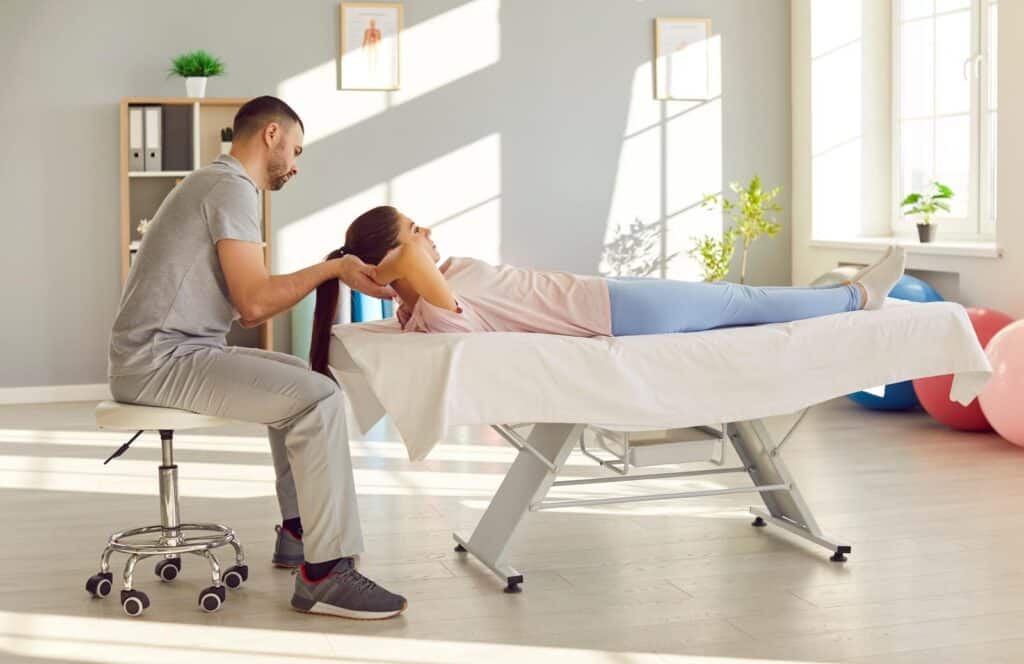
If you have been told that your spinal alignment, posture, or spinal curvature is different from what is considered typical, you may have heard about corrective spinal traction as part of a chiropractic or rehabilitation plan.
But what does corrective spinal traction actually do?
Corrective spinal traction is a structured form of traction that uses controlled positioning and mechanical loading to place specific forces on the spine. Depending on the treatment approach and the individual patient, the goal may be to influence spinal position, mobility, posture, or a measurable alignment finding over time.
This approach differs from the idea that traction simply “pulls the spine back into place” during one appointment. **Corrective spinal traction** is typically part of a broader plan based on the individual’s symptoms, examination findings, mobility, goals, and overall health.
What Is Corrective Spinal Traction?
Corrective spinal traction is a form of spinal traction designed around a specific clinical or structural goal.
Traditional traction may be used with the goal of temporarily reducing symptoms or changing how a patient tolerates certain movements. Corrective spinal traction takes a more structure-focused approach by using a particular position, direction of force, duration, and treatment frequency.
Depending on the area being treated, corrective spinal traction may involve positioning the cervical, thoracic, or lumbar spine in a specific direction.
The treatment may be used alongside other forms of chiropractic care, corrective exercises, mobility work, strengthening, or rehabilitation.
The important point is that corrective spinal traction is not simply a stronger version of ordinary traction. The treatment should have a reason behind the position and loading strategy being used.
How Does Corrective Spinal Traction Work?
Corrective spinal traction works by applying a controlled mechanical force to the spine while the patient is positioned in a specific way.
The exact setup depends on the area being addressed and the goals of care.
A corrective spinal traction session may involve:
- A specific spinal position
- Controlled traction or extension forces
- A selected treatment duration
- Repeated treatment sessions
- Progressive changes to positioning or loading
- Exercises that complement the traction approach
- Periodic reassessment
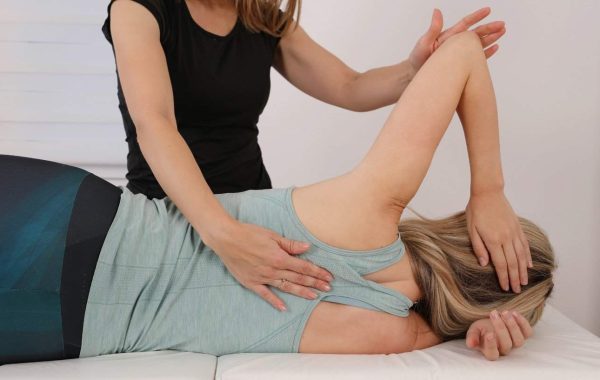
The purpose is not to force the spine into a new position during one treatment.
Instead, a structured program may use repeated exposure to a particular mechanical stimulus while monitoring how the patient responds.
That distinction matters because spinal alignment, mobility, muscle function, and symptoms are not controlled by one variable.
Corrective Spinal Traction vs. Regular Spinal Traction
The word traction can describe several different treatment approaches.
Some traction treatments are primarily symptom-focused. For example, a clinician may use traction as part of care for certain neck or back complaints with the goal of reducing symptoms or improving movement tolerance.
Corrective spinal traction is different when the treatment is specifically being used to address a measurable structural or postural finding.
The intended goal should be explained before treatment begins. Rather than simply saying that a patient’s posture is “bad,” a clinician should be able to explain:
- What finding is being addressed
- Why that finding matters
- Whether it appears reasonably modifiable
- What treatment is being proposed
- How progress will be measured
This makes corrective spinal traction a more individualized process than simply placing someone on a traction table.
What Can Corrective Spinal Traction Address?
The potential goals of corrective spinal traction depend on the patient’s evaluation and the specific technique being used.
A clinician may consider traction when assessing findings such as:
- Reduced cervical lordosis
- Certain postural changes
- Some forms of altered spinal alignment
- Reduced spinal mobility
- Specific extension-related restrictions
- Certain measurable sagittal alignment findings
However, a measurement outside a reference range does not automatically mean that it needs to be corrected.
Spinal alignment varies naturally between individuals, so a structural difference may be significant in one case but not another. Symptoms, function, examination findings, medical history, and goals should be considered alongside imaging or posture measurements.
Does Corrective Spinal Traction Straighten the Spine?
Not in the simplistic sense that the spine can be permanently “straightened” during a single treatment.
The spine is a living, moving structure. Its position is influenced by muscles, joints, connective tissues, movement habits, age, injury history, degeneration, and many other factors.
When corrective spinal traction is used for a structural goal, the intent is generally to influence a particular alignment or movement pattern through repeated, controlled treatment.
Research has reported measurable changes in cervical alignment in some structured traction-based protocols, but that does not mean every spinal curve is correctable or that a change on an X-ray automatically produces better health outcomes.
This is an important distinction when discussing corrective spinal traction.
Potential structural change and guaranteed correction are not the same thing.
Does an Abnormal Spinal Curve Always Need Correction?
No.
A spinal curve can look different from a reference value without representing a disease or requiring treatment.
Before pursuing corrective spinal traction, it is reasonable to consider:
- Whether symptoms are present
- Whether movement is limited
- Whether daily activities are affected
- Whether the spinal finding is flexible
- Whether there are degenerative changes
- Whether there is a history of injury or surgery
- Whether neurological findings are present
- Whether the condition is stable
- What the patient actually wants to improve
For example, someone may have a measurable postural difference but no pain, disability, or functional limitation.
In that situation, the presence of an unusual measurement alone does not establish that corrective spinal traction is necessary.
Who May Benefit From Corrective Spinal Traction?
Whether corrective spinal traction is appropriate depends on the individual, not just an X-ray. An evaluation may consider:
- Posture and spinal movement
- Flexibility, strength, and balance
- Symptoms and functional limitations
- Neurological findings
- Previous injuries or spinal procedures
- Treatment goals
When clinically appropriate, imaging can provide additional information about spinal alignment and structural findings. It should support the overall evaluation rather than determine treatment on its own.

Can Corrective Spinal Traction Help Neck Pain?
Traction is used in some treatment programs for people with neck-related symptoms, although the evidence depends on the condition and the specific traction protocol.
For example, a 2026 randomized controlled trial found improvements in neck pain and cervical range of motion in patients with cervical radicular symptoms who received cervical traction as part of a broader treatment program.
That does not mean corrective spinal traction is appropriate for every person with neck pain.
Neck pain can have many causes, and treatment should be based on the individual’s presentation rather than the assumption that spinal alignment is the primary cause.
What Does the Research Say About Corrective Spinal Traction?
Research on corrective spinal traction varies by the technique, condition, patient population, and treatment goal. Some studies have reported measurable changes in cervical alignment following structured traction programs, along with improvements in certain symptoms.
However, results from one protocol or patient group cannot be applied to everyone. Changing an X-ray measurement also does not necessarily mean that pain or function will improve.
Overall, the evidence suggests that certain traction approaches may influence spinal alignment in selected patients, but more research is needed to determine when these changes provide meaningful long-term benefits.
Is Corrective Spinal Traction Painful?
Corrective spinal traction should not be assumed to be painful simply because it involves mechanical loading.
The experience can vary depending on:
- The area being treated
- The patient’s condition
- Positioning
- Amount of force
- Treatment duration
- Individual tolerance
A clinician should monitor the patient’s response and modify the treatment when appropriate.
Severe or unusual pain, worsening neurological symptoms, new weakness or numbness, or other concerning changes should not simply be dismissed as a normal part of corrective care.
How Long Does Corrective Spinal Traction Take to Work?
There is no universal number of treatments that applies to everyone.
If corrective spinal traction is being used with a structural goal, changes are generally evaluated over time rather than expected from one appointment.
The treatment plan may depend on:
- The structural finding
- Spinal flexibility
- Symptoms
- Age
- Previous injuries
- Existing degeneration
- Treatment tolerance
- Response to care
- The specific traction technique
A good plan should include opportunities to reassess whether the treatment is producing the intended result.
More treatment is not automatically better.
How Is Progress Measured With Corrective Spinal Traction?
Progress should not be judged solely by whether an X-ray looks different. Depending on the reason for care, progress may include changes in:
- Pain
- Range of motion
- Strength
- Mobility
- Exercise tolerance
- Work tolerance
- Sitting or standing tolerance
- Daily activities
- Headache frequency
- Overall function
If changing spinal alignment is one of the treatment goals, structural measurements may also be considered. This creates a more complete picture of whether corrective spinal traction is helping the patient achieve meaningful goals.
Does Corrective Spinal Traction Need to Be Combined With Exercise?
Often, a broader rehabilitation approach can be useful.
Traction is a passive treatment—the clinician or equipment applies the mechanical force. Exercise gives the patient an active role in developing strength, mobility, endurance, balance, and movement capacity.
Depending on the individual, a chiropractic plan may include:
- Corrective exercises
- Strength training
- Mobility exercises
- Postural training
- Movement education
- Balance work
- Conditioning
- Home exercises
The appropriate combination depends on the patient’s goals and clinical findings. The goal should be to help the person become more capable of managing movement and physical activity.

Is Corrective Spinal Traction Safe for Everyone?
No treatment is appropriate for everyone.
Before using corrective spinal traction, a clinician should consider the patient’s health history, symptoms, examination findings, previous injuries or surgeries, and other factors that could affect treatment.
Certain spinal conditions may require a different approach or additional medical evaluation before traction is considered.
Patients should also tell their provider about new or worsening symptoms during treatment.
Corrective care should be individualized rather than applied according to a one-size-fits-all protocol.
What Should You Ask Before Starting Corrective Spinal Traction?
If a provider recommends corrective spinal traction, consider asking:
What are we trying to change? You should understand the specific finding or functional problem being addressed.
Why does it matter? A measurable difference does not automatically mean that correction is necessary.
How long will we reassess before changing the plan? A treatment plan should have reasonable checkpoints.
How will we measure progress? Ask whether progress will be evaluated through symptoms, physical function, movement, imaging, or a combination.
What happens if I am not improving? There should be a plan for modifying treatment when the expected response does not occur.
What happens when I finish care? A good rehabilitation plan should include a path toward maintaining improvements through movement, exercise, activity, and self-management when appropriate.
Corrective Spinal Traction at True Grit Health Center
At True Grit Health Center in Wentzville, MO, corrective spinal traction may be considered as part of an individualized chiropractic approach when the patient’s evaluation supports that type of care.
The goal is not simply to change an image.
The more important questions are whether a particular spinal finding is relevant to the person, whether it appears reasonably modifiable, and whether addressing it can support meaningful improvements in movement, comfort, or function.
A thorough evaluation can help determine whether corrective spinal traction is appropriate and what other components of care may be useful.
Frequently Asked Questions About Corrective Spinal Traction
What is corrective spinal traction?
Corrective spinal traction is a structured traction approach that uses controlled positioning and mechanical loading with a specific treatment goal. Depending on the individual, that goal may involve spinal alignment, mobility, posture, or another measurable finding.
How does corrective spinal traction work?
Corrective spinal traction applies controlled mechanical forces to the spine in a specific position. Repeated treatments may be used as part of a broader rehabilitation plan while the patient’s response is monitored.
Can corrective spinal traction change spinal curvature?
Some structured traction-based research has reported measurable changes in certain spinal alignment findings, particularly cervical alignment. However, results vary, and corrective spinal traction should not be presented as a guaranteed method of permanently changing every spinal curve.
Is corrective spinal traction the same as regular traction?
Not necessarily. Traction can be used for different purposes. Corrective spinal traction generally refers to a more structure-focused approach in which a specific alignment or postural goal is part of the treatment plan.
How many corrective spinal traction sessions will I need?
There is no universal treatment schedule. The appropriate frequency and duration depend on the patient’s condition, goals, response to treatment, and the specific approach being used.
Do you need an X-ray for corrective spinal traction?
Not every person needs imaging. When structural correction is being considered, imaging may sometimes provide useful information, but the decision to obtain or repeat imaging should be based on clinical need.
Can corrective spinal traction help neck pain?
Traction may be included in treatment for some neck-related conditions, but it is not appropriate for every cause of neck pain. The treatment approach should be based on an individual evaluation.
Learn More About Corrective Spinal Traction in Wentzville
If you have been told that you have an altered spinal curve, posture, or alignment and want to understand what it means, an evaluation can help put the finding into context.
Corrective spinal traction may be appropriate for some patients, but the important question is not simply whether a measurement can be changed. The goal is to determine whether addressing that finding makes sense for you and whether it connects to something meaningful in your health or function.
True Grit Health Center in Wentzville, MO can evaluate your individual needs and discuss whether corrective spinal traction or another chiropractic approach may be appropriate.
Schedule an appointment to discuss your spinal alignment, symptoms, and treatment options.